Intelletto.ai — Talent Intelligence Platform · Full Overview
WHAT INTELLETTO ACTUALLY IS

Most résumés don’t get read.
We’re trying to fix that.

Intelletto plugs into the ATS you already run. It reads every résumé that lands there, scores it against the actual job you posted, and tells you why — with the source passage attached, so a regulator (or a hiring manager, or the candidate themselves) can check the work.

No rip-and-replace Explainable by design Seniority-aware scoring GDPR · PDPA · LL 144 ready Measurable lift, current quarter
35%
Cost
per Hire
50%
Time
to Fill
60%
Screening
Cost
40%
Recruiter
Capacity
THE PROBLEM
The real problem isn’t résumé volume. It’s that most résumés never get a real look. If you ran a busy req last quarter, the math is brutal. Meaningful triage of about 30% of inbound. The other 70% is silent rejection — not because anyone decided no, but because the queue ran out of time. That’s not a hiring decision. That’s a queue.
OK SO WHAT DOES IT ACTUALLY DO

Three things. One underlying engine.

You can think of Intelletto as three products that share a single pipeline and a single audit trail. Most teams turn one on first — usually Talent — and add the others as the value compounds. None of them require a replatform.

01 — Talent Intelligence
Turn 200 messy PDFs into 200 comparable profiles.
Every résumé gets read, structured, normalised against your skills taxonomy, and stored as a profile that can be compared, sorted, and searched. The audit trail goes back to the bytes of the source PDF.
50%
Faster
shortlist
40%
Hours
saved
15%
False
negatives ↓
02 — Outcome Intelligence
Scores that mean something specific.
Nine buckets scored against each role, weighted differently for each seniority band. Then we follow the people you actually hired and check the score against their 30/90/180-day outcomes — so the rubric tightens after every cohort, not just every quarter.
25%
Early perf
uplift
20%
Faster
ramp
15%
Attrition
03 — Governance Intelligence
Decisions you can show your work on.
Every recommendation ships with reason codes, a confidence score, and the source passages that justify it. Every sealed scorecard now produces a fourteen-page Audit Report — open it inline from the dashboard, or download the signed bundle and hand it to a regulator who runs our open-source verifier on their own machine. Fairness monitors run on a schedule, not on demand.
60+
Candidate
NPS
100%
Decisions
auditable
Rollback
at any stage
HOW IT PLUGS IN

We plug in. Nothing else changes.

Two sides of the same commitment. No new system for anyone to log into. And no automated decisions until your team has watched the model long enough to trust it.

THE SIDECAR MODEL
We talk to your ATS through APIs. That’s the whole integration story.
The change-management slide for this is one line: a new feed appeared inside the tool your team already uses. No new login, no new dashboard to learn, no “is everyone trained on the new platform yet” meeting. Intelletto reads from and writes back to the systems below, and that’s the integration.
SAP SuccessFactors Workday Oracle HCM Greenhouse Lever BambooHR Salesforce
THE ROLLOUT PATH
Shadow → Gated → Automate (you decide how fast)
Shadow. Intelletto runs in parallel and produces scores nobody acts on. You compare them to what your team would have done. This is the “is this thing any good?” phase.

Gated. Recommendations now show up in the recruiter’s view, but every one needs a human approve / edit / decline. Every override the human makes gets logged and feeds the model.

Automate. Only on the requisitions you say so, only above the confidence threshold you set. Pull the threshold back any time. There is no one-way door.
UNDER THE HOOD

How a résumé turns into a score you can defend.

12
pipeline
stages
5
quality
gates
9
scoring
buckets
5
score
modifiers
4
pipeline
modes
THE TWELVE STAGES

Twelve stages. Five quality gates.

The first four stages answer four boring questions — what document, who owns it, have we seen it, what does the page actually say. The middle stages do the AI work. The last stages produce the artefacts a recruiter looks at. Same path, every time.
01
Register & Track
A file lands. We assign it a tracking ID, hash the bytes, link it to a job code if there is one, and remember exactly when and where it arrived.
02
Have we seen this person?
Byte-level match catches the obvious. Email + name + phone catches the “same person, slightly different PDF” case. If it’s a dupe, the run ends here.
03 – 04
Actually read the document
Google Document AI handles the OCR + layout. We strip the headers, footers, watermarks, page numbers — anything that isn’t the content the candidate wrote.
Gate A — Lossless
05
Pull out the structure
Gemini extracts skills, roles, achievements, certifications, languages, and executive signals into a typed JSON schema. Every claim is bound to the passage that supports it — or it doesn’t make it through.
Gate B — Schema
06
Speak the same language
“K8s”, “Kubernetes”, and “container orchestration” all collapse to the same node in your taxonomy. Certifications expand into the skill basket they imply.
Gate C — Evidence
07
Look around the web
LinkedIn, personal site, GitHub. We actually fetch the pages (not pretending to) and corroborate the claims. New skills found here carry the source they came from, forever.
08 – 09
Freeze the inputs before scoring
All five gates evaluated, every verdict logged. If the candidate gets through, we take a snapshot of everything that’s going to feed the scorer and hash it — so a re-score next year reproduces the same number bit-for-bit, or you know exactly why it didn’t.
Gates D + E
10 – 11
Score against the actual JD
The nine scoring buckets get weighted for the seniority of the role. Five modifiers refine the base score with evidence quality, outcome signals, and two risk rubrics. The full scorecard — every bucket, every modifier, every passage — is saved permanently and never overwritten.
12
Hand the recruiter something they can use
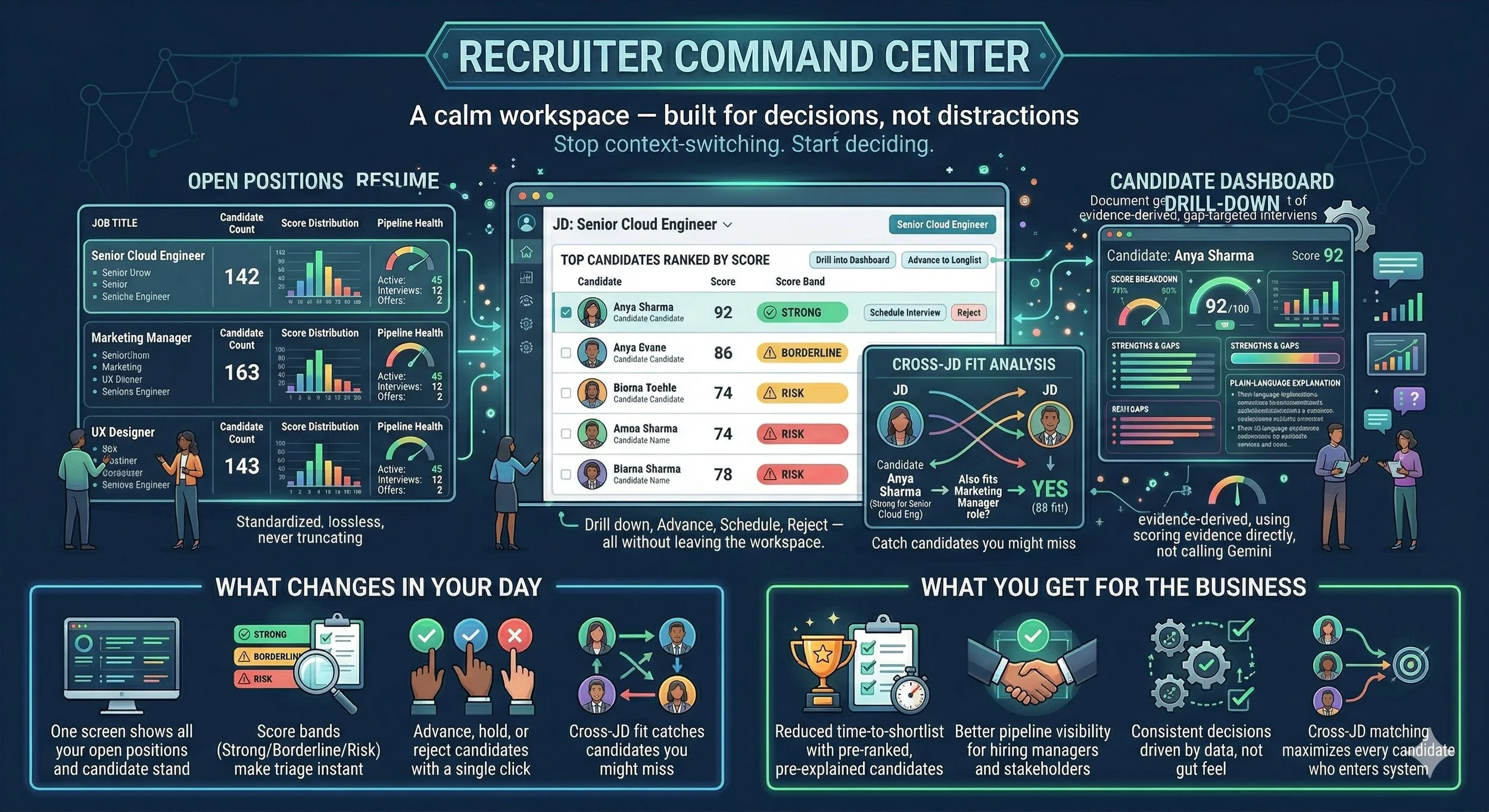
Ranked shortlist. Per-candidate scorecard with matched + missing skills. Risk flags. Quality checklist. An audit packet a regulator can read end-to-end. All of it landing inside the tool the recruiter already uses.
Intelletto.ai — 12-stage intelligence pipeline diagram
FIVE QUALITY GATES

Five questions we ask before a score is allowed to happen.

A score that came out of broken inputs is worse than no score — it’s a number someone will trust. So before the scorer runs, every candidate has to pass five gates. Two of them are hard stops. Two are warnings the recruiter sees. One is a quality summary attached to the artefact. Whatever happens, every verdict ends up in the audit packet.

Gate What it asks If the answer is no Verdict
A · Lossless Did the OCR actually read every page? Did anything drop silently? Flag it. A human re-reads. Pipeline continues. WARN
B · Schema Did the AI return the exact JSON shape we asked for? Hard stop. A malformed extraction is not allowed to become a score. BLOCK
C · Evidence Does every claim trace back to a passage in the source document? Show the low-evidence claims to the recruiter. They decide. WARN
D · Dedup Have we already processed this person in your pool? End the run as a duplicate. The original record stays untouched. BLOCK
E · Artefacts URL quality, bounding boxes, normalisation hits, work history present? Attach a quality summary. The score stays visible. PASS
WHERE THE AI ACTUALLY FIRES

AI isn’t a feature here. It’s running in about two dozen places.

Most platforms bolt AI onto one step — usually résumé parsing — and call it done. We use structured-output AI all the way across the hiring loop. Every call is locked to a schema and bound to an evidence contract, so we get back something we can actually use (not just “text the AI made up”).

Source & Search
Find the right people, faster.
Type what you actually want — “senior Python person who’s shipped a real machine-learning system, not just done a Kaggle” — and the search figures out the intent. Direct-PDF extraction skips the OCR tax for clean documents.
Query Intent Semantic Scoring Direct-PDF
Understand the candidate
Read every claim, then go check it.
Normalise the skills against your taxonomy. Actually fetch the websites the candidate listed (we found a lot of platforms quietly skip this step). Pull trajectory signals out of the shape of the career, not just the headline.
Skill Normalisation Web Enrichment Trajectory Signals
Define the role
The JD itself is AI-shaped.
AI JD generator. A bank of role-appropriate interview questions. Title-to-SOC mapping (so “Ninja Engineer III” resolves to a real occupation). Cert-to-skill expansion, so an AWS Solutions Architect Pro carries its skill basket with it.
AI JD Questions Cert → Skills
Score the fit
A rubric that knows the role.
Bucket weights shift by seniority. A three-pass skill verifier (stem match → alias map → AI fallback) catches the cases where a candidate described their experience in paraphrased terms instead of the exact words the JD used.
Role-Normative Hybrid Verifier
Engage & interview
Messages a candidate would actually open.
Branded outreach, customised per candidate — not generic “hi {first_name}” templating. Interview briefs that surface the candidate’s gap-and-strength shape, so the hiring manager doesn’t spend the first 20 minutes re-reading the JD.
Outreach Branded Interview Briefs
Police its own bias
Audit the AI’s own writing, every time.
A separate auditor reviews everything the platform generated — JD copy, outreach text, score rationale — across four bias dimensions. Never blocks the work. Always logged. The next section unpacks what it’s actually looking for.
Bias Auditor
HOW WE SCORE

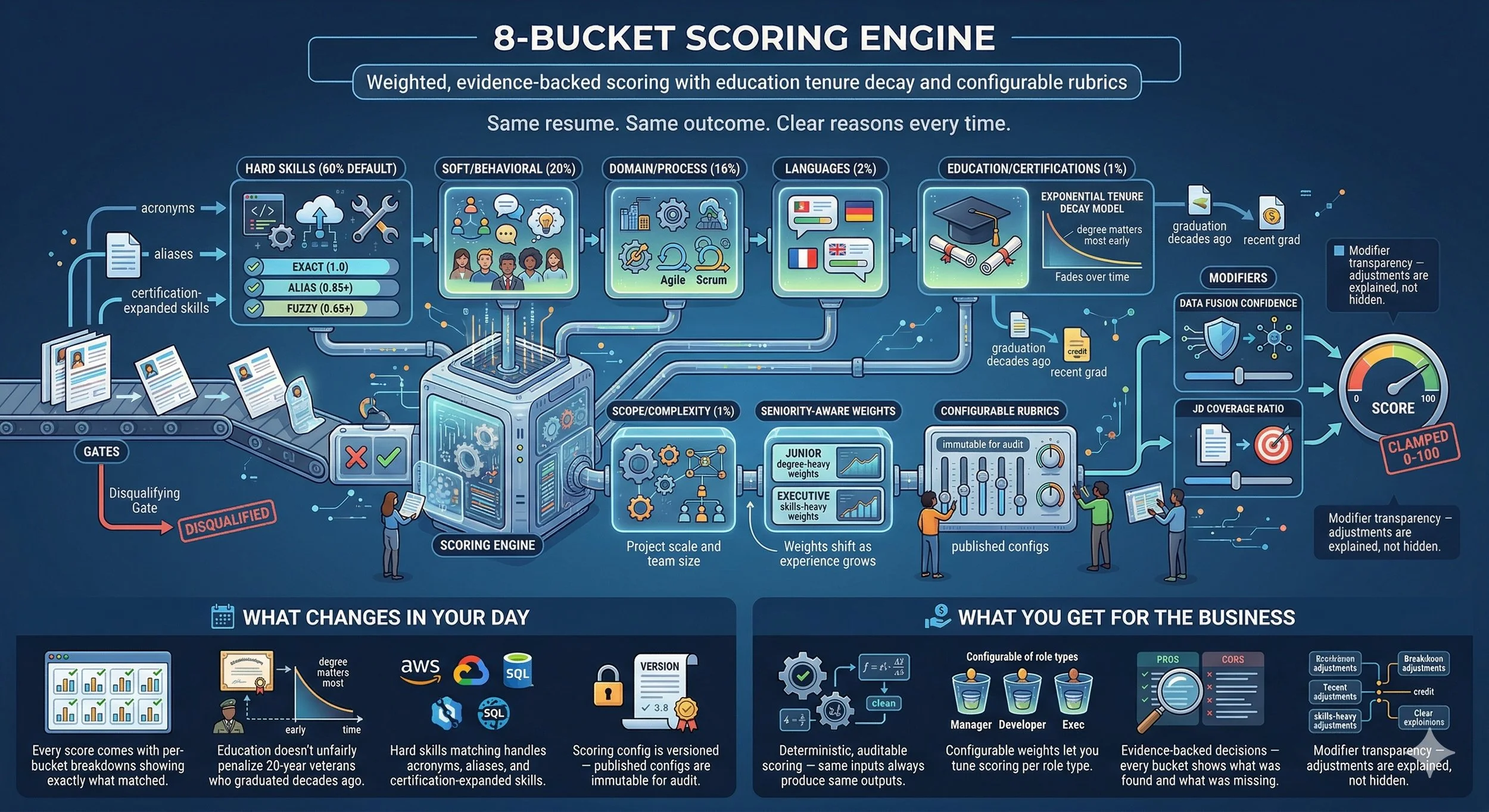
Nine buckets. Four seniority profiles.

Here’s the awkward thing about generic scoring engines: a graduate engineer and a COO can’t share the same rubric. What gets a junior shortlisted is not what gets a chief operating officer shortlisted. So we don’t make them share. The same nine buckets exist for every role, but the weights flip as the job gets more senior. “Can you do the work?” becomes “can you scale the work?” becomes “can you own the function?” becomes “can you stand behind it?”

9 Scoring Buckets
Hard Skills & Tools
↑ Jr
Soft Skills & Leadership
↑ Exec
Domain & Industry Expertise
↑ Exec
Scope & Complexity
All
Tenure & Recency
↑ Jr
Education & Certifications
↓ Exec
Languages & Communication
All
Culture Fit
All
Compliance & Quality
Knockout
Weights shown for Junior/Mid profile. Seniority band automatically shifts emphasis; Compliance acts as a knockout rather than a weighted contribution.
Seniority Weight Profiles
Band Hard Leadership Domain Modifier Budget
Junior / Mid 55% 10% 10% ±8 pts
Senior / Lead 45% 15% 15% ±10 pts
Director / VP 30% 20% 20% ±14 pts
C-Level / Exec 15% 30% 25% ±16 pts
A NOTE ON CERTIFICATIONS
A candidate with AWS Solutions Architect Pro probably knows what EKS is, even if their CV doesn’t mention it.
This is one of the small, infuriating ways résumé scoring goes wrong. The candidate holds a senior cloud credential. The JD asks for “EKS” in those exact three letters. The naive scorer says zero match.

We fix it by linking 200+ industry-recognised certifications back to their underlying skill basket through the DoL occupation taxonomy. If you hold the credential, you carry its skills with you — at a confidence-weighted match that reflects how recent the cert is and how tightly it maps to the requirement. Nobody gets penalised because their narrative was tight rather than exhaustive.
Intelletto.ai — 9-bucket scoring engine
MODIFIERS · APPLIED AFTER THE BASE SCORE

The bits the base score can’t see on its own.

The base score is “how well do their skills line up with the requirements?” That’s a real question, but it’s not the whole question. Five modifiers add and subtract from the base to catch evidence quality, quantified outcomes, and two flavours of risk. Every one of them is itemised on the scorecard — a recruiter can see exactly which modifier shifted the score by how many points and why.

🎯
Data Fusion Confidence
How clean were the taxonomy matches? Exact hits across the candidate’s skills boost the score. A lot of fuzzy fallbacks — “we think this is probably the same thing” — pulls it back.
−6 to +8 (C-Level)
🔗
Evidence Coverage
What share of the JD’s requirements actually have a matching passage in the candidate’s document? Above about half, you get a bump. Below it, the score gets pulled down to match the actual evidence.
−4 to +6
📈
Outcome Evidence
Did the candidate quantify anything? “Reduced infra cost by 32%”, “grew ARR by $14M”, “scaled the team from 6 to 40”. Specific numbers in a résumé are a strong, cheap trust signal.
−4 to +7
🛡️
Stability Risk
A seven-factor look at job-hopping, average tenure, the gap pattern, continuity through changes, and progression momentum. The point isn’t to punish short tenures — it’s to flag when the shape of the career suggests this role won’t stick.
−4 to +3
🔄
Role-Switch Risk
Seven factors again: how big is the gap to the target role, does the seniority line up, how recent are the relevant skills (we decay them over 24 months), is the candidate moving across a function they’ve never lived in?
−3 to +3
WE POLICE OUR OWN AI

Every word the AI writes gets read by a different AI.

One thing worth being clear about: the auditor only looks at what Intelletto wrote. Not the candidate’s résumé. Not the hiring manager’s notes. Just the AI-generated text — job descriptions, outreach drafts, score rationale. If it spots loaded language, it surfaces the finding and suggests a rewrite. A human always decides what to do with it. It never blocks the work, and every finding gets logged.

♂♀
Gendered Language
“Rockstar”, “ninja”, “aggressive”, excessive “nurturing”. These quietly tilt the applicant pool. The auditor suggests a more neutral phrasing.
gender
Age Signals
“Digital native”, “young and energetic”, “recent grad”. The shortcut here is age. The auditor names it and asks what the underlying skill actually was.
age
🌍
Race, Ethnicity & Origin
“Native speaker”, “no accent”, geography shorthand that’s really about where someone’s from. Often unintentional. The auditor proposes a fluency or competency requirement instead.
origin
Disability & Family
Physical-ability presumptions (“must be able to…” when the role doesn’t actually require it) and family-status filters that don’t predict performance.
disability / family

One quirk worth knowing. A finding on a JD or an outreach draft turns into a rewrite suggestion you can accept or ignore. A finding on score rationale is annotated, never overwritten — because the scorecard is immutable evidence and we’re not in the business of rewriting history.

FOUR MODES, ONE PIPELINE

Pick the path that matches how you actually hire.

Same twelve stages, four different paths through them. The mode is a per-requisition (or per-source, or per-team) choice. You can use all four in the same week without anyone’s permission.

Mode What it does Use when… Ends in
A · Pool Prep Read, normalise, gate — don’t score yet. You’re building a pool of pre-qualified people for roles you haven’t opened yet. POOL_READY
B · Pool Activation Take a pool candidate and score them against a JD that just opened. A req opens, you already have great candidates in your pool, you want answers in minutes. PROCESSED
C · Full Auto The whole thing: read, score, shortlist, in one pass. Standard inbound for a live req. The most common path. PROCESSED
D · Bulk Import High-volume ingest, plus a clean Intelletto-format résumé per person. You’re migrating from another ATS, importing an agency dump, or absorbing a historical pool. POOL_READY

The modes are just the start. Skill taxonomy, bucket weights, auto-score thresholds, knockout criteria, RBAC permissions, culture-fit pillars — everything that matters is configurable per-tenant. We’re not trying to impose a hiring philosophy on you. You bring the philosophy. Intelletto executes it.

WHY YOU CAN TRUST THE NUMBER

Five reasons every Intelletto score holds up when someone asks “why?”

The person being scored, the manager doing the hiring, and the regulator reviewing the process all eventually ask the same question: where did this number come from? A scoring engine that can’t answer that question shouldn’t be making recommendations about people’s careers. Here’s how Intelletto answers it.

01 · Provenance
Every score traces back to the bytes.
The number → the scorecard version that produced it → the snapshot of inputs that fed the scorer → the structured extraction → the OCR page map → the source PDF. Every link in that chain is SHA256-hashed. There is no “trust us” step.
02 · Evidence per claim
No score without a source passage.
Every bucket inside the scorecard exposes the matched and missing skills, with the exact line from the document next to each one. If we can’t cite what we’re crediting the candidate for, we don’t credit it — that’s what the evidence gate is for.
03 · Versioning, not overwrites
Re-scoring never destroys history.
Edit the taxonomy. Tweak the JD. Adjust a weight. None of that overwrites yesterday’s score — it creates a new scorecard_version alongside the old one. The original score, the original snapshot, and the original rubric all stay intact.
04 · Configurable, not magic
Every weight is yours; every change is logged.
The bucket weights, modifier ranges, gate thresholds, and what counts as “the same skill” are all tenant-owned. Every change writes a record — so a regulator can reconstruct exactly what the rubric looked like on the day a given decision was made.
05 · One-click Audit Report
A 14-page report and a signed bundle, ready on demand.
Every sealed scorecard ships with an Audit Report: cover sheet with the verdict, bucket-by-bucket evidence with matched and missing items, the full SHA256 chain from PDF to score, the pipeline stage outcomes, the rescore history. Recruiters open it inline. Auditors download the signed bundle and run our open-source verifier — on their own machine, against the immutable input snapshot — and get back a single line: VERIFIED. That’s the bar. Not “trust our signature”: re-run the scoring yourself and see you get the same number.
GOVERNANCE IS BAKED IN

Not an afterthought. Not a checklist someone fills in after launch.

Security, privacy, fairness, reliability. The four words every enterprise software page lists in the footer. Worth saying what they actually mean here.

Security
Encryption in transit and at rest. Role-based access with scoped tokens. Least-privilege defaults at every pipeline stage — no service has more read or write power than it needs for its specific job.
Privacy
Aligned with GDPR, PDPA, and similar regimes. Data access is purpose-limited — what you can read is gated by why you’re looking. Every extraction and every decision lands in an audit trail you can export.
Fairness
Fairness monitors run continuously, not on request. Every artefact is signed. Every scoring run is reproducible. A bias report — the kind a regulator asks for — is exportable in one click.
Reliability
p95 latency targets per stage. Structured retries on the calls that can flake. Graceful degradation when a downstream service is having a moment. One-click rollback at every stage — because sometimes you just need to put yesterday’s pipeline back.